How a pitcher does
what a plumbed system does.
Four filtration technologies in one patented carbon matrix. Engineering in the open, verification on a published timeline.
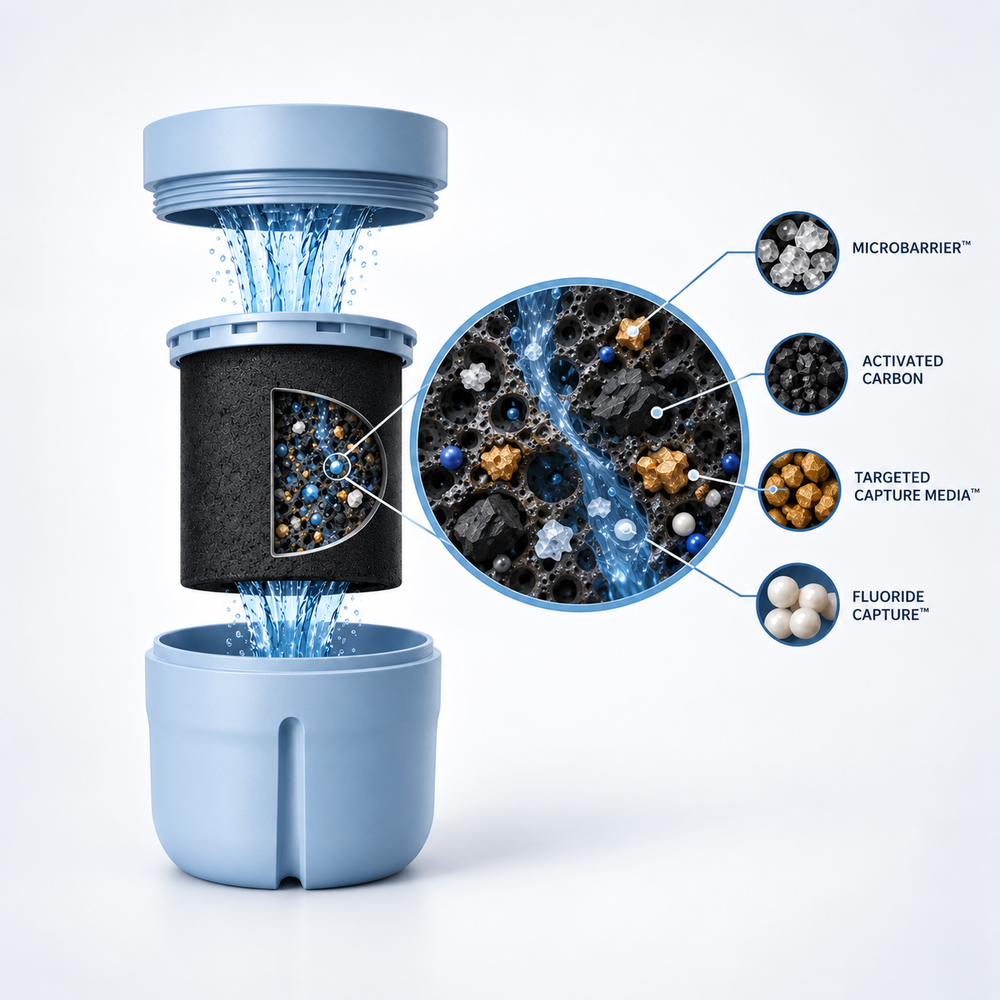
Not just carbon. Four filtration technologies in one patented matrix.
Most pitcher filters rely mainly on activated carbon. Osma goes further. Multi-Capture™ Carbon Matrix combines multiple filtration mechanisms inside one solid block — each designed to tackle a different type of contaminant.
MicroBarrier™
Physically traps microplastics, rust and sediment.
Activated Carbon
Captures chlorine, pesticides, pharmaceuticals and other organic contaminants.
Targeted Capture™
Specialized media target PFAS, lead and other heavy metals.
Fluoride Capture™
Dedicated filtration media reduce fluoride, while naturally occurring calcium and magnesium remain in the water.
That’s how Osma delivers advanced, near-RO filtration in the convenience of a pitcher.
Filter life 568 L per filter · about 3 monthsWater waste 0 · no wastewater
Minerals Calcium + magnesium stay
What "NSF certified" actually means.
Most filter brands wave the NSF logo without telling you which standard. The number is the whole story. Three standards apply to drinking-water filters; Osma is certified to all three.
Aesthetic effects
Chlorine, taste, odor, particulate. The baseline standard most pitchers test against. Says nothing about health-related contaminants.
Health effects
Lead, mercury, VOCs, chromium-6. The serious standard — testing protocol requires sustained removal across the filter's entire claimed lifespan.
Emerging contaminants
PFAS (PFOA / PFOS), pharmaceuticals, pesticides, hormones. The standard most pitchers don't carry. NSF/ANSI P473 is the PFAS-specific subset.
Tested by people we don't pay.
Annual third-party testing by an accredited laboratory. The accreditation number is below — you can verify it independently.

Each year a fresh production-line pitcher is sent to an accredited third-party laboratory. They run the NSF/ANSI 53 and 401 protocols, document the methodology, and we publish the results — pass, fail, or middling.
Sample type: production-line. Test frequency: quarterly. Full certification publishing on a timeline this year — certification body and accreditation number disclosed at that time.
Request the test summary →Why we built this.
The shortest brand story we could honestly write.
We started Osma because we couldn’t find a pitcher that removed PFAS at the level reverse osmosis does. We built one that does, engineered it to NSF/ANSI 53 and 401 protocols, and committed to retesting every year and publishing the results.
Six people on the team. One factory partner, contracted to our spec. Every customer email lands in one of our inboxes — write to us, one of us writes back.
Saying it plainly.
The most useful part of any product page is the part that says what it doesn't do.
- Not for well water with bacteria — you need UV, not us.
- Not a softener — if your problem is limescale in the kettle, look elsewhere.
- Not a pre-checked subscription, ever. You opt in, deliberately.
- Not 100% pure water — we keep the magnesium and calcium, on purpose.
- Not endorsed by anyone we paid for an endorsement.
- Not the cheapest pitcher, and we don't try to be.